
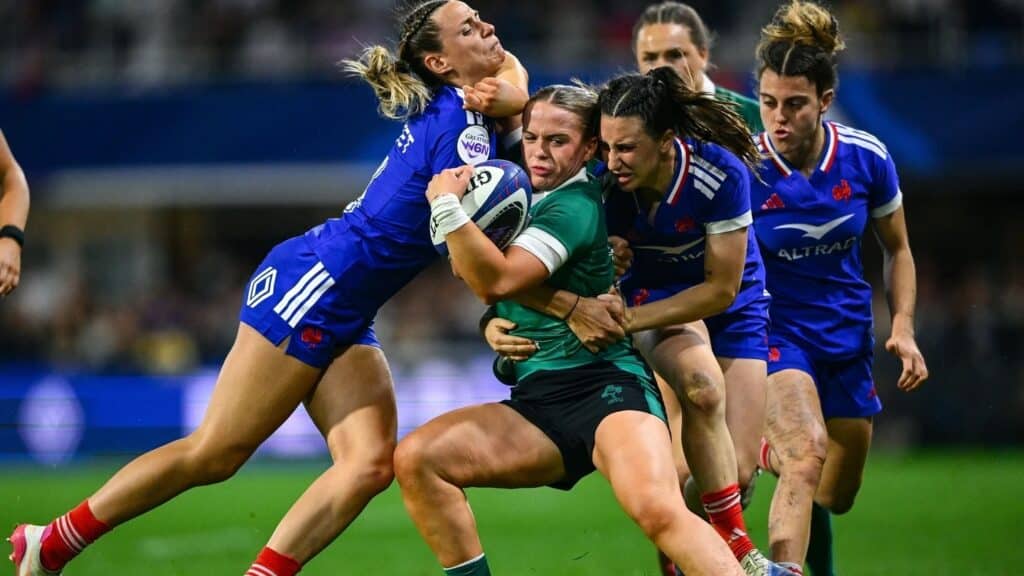
Young gun Robyn O’Connor has been backed for her third start against Wales in Belfast this weekend
Richard Bullick
AFTER a fallow week which gave everyone a welcome chance to breath after a hectic first phase of the Six Nations, Ireland return to action against Wales at Ravenhill on Saturday (6.30pm) in what will be the first of two home matches in eight days.
There are already more than 25,000 tickets sold for next Sunday’s historic clash with Scotland in Dublin, the Aviva Stadium’s first standalone women’s match, and two wins would give Ireland three victories in a single campaign for the first time since 2020.
Eve Higgins has been recalled at inside centre in place of Nancy McGillivray as the only change to the starting team which faced France last time out, while Ulster’s Sadhbh McGrath, the uncapped Niamh Gallagher and Grace Moore come onto the bench.
McGrath is included instead of Niamh O’Dowd so will cover her original international role of loosehead prop as part of a replacements panel with a 6:2 split as McGillivray and Anna McGann both drop out of the matchday 23.
Vice-captain Fiona Tuite and McGrath are the only two current Ulster players involved but the English-based duo of blindside flanker Brittany Hogan and bench hooker Neve Jones will also be flying the flag for the northern province at their provincial headquarters.
A third consecutive third place finish, but with three wins this time, would consolidate Ireland’s standing as ‘best of the rest’ in the Six Nations but it also feels like they are closing the gap with the established Big Two.
Ireland started slowly in the opening game against England at Twickenham, but if ever a harsh scoreline completely failed to reflect the true nature of a seismic contest, it was Ireland’s 26-7 defeat against France in that absorbing, brutal battle in Clermont.
After thrashing Italy 57-20 in Galway seven days earlier, the girls in green had been bullish about their bid to make history with Ireland’s first-ever away win against France and avenge last September’s agonising defeat in a stormy World Cup quarter-final.
Scott Bemand’s side backed up their words with a wonderfully ferocious first half display, though there were worries at the interval that Ireland could come to regret having so little to show on the scoreboard for their incredible dominance in that opening period.
France have very much been a second half team in this Six Nations so far, pulling away against both Italy and Wales after the break and here they scored 19 unanswered points securing the bonus-point with their fourth try on 79 minutes.
It was 7-7 after a first half of frightening intensity in which Ireland were awarded four tries but had no fewer than three of them chalked off retrospectively after forensic reviews by the Television Match Official.
Either side of their only try which stood, scored by hooker Cliodhna Moloney-MacDonald, Ulsterwoman Hogan was denied due to a double movement and Tuite couldn’t get the ball grounded cleanly thanks to a brilliant French cover tackle.
The supremely pumped-up Moloney-MacDonald looked to have got her second touchdown on the half hour but replays showed there had been a little knock-on by scrumhalf Emily Lane at the base of the previous ruck so that try didn’t stand either.
None of those decisions could be disputed on the evidence available, but what really left a sour taste and sense of injustice was the fact France’s first half try wasn’t looked at afterwards despite Aoife Wafer appearing to have kept the ball from being grounded clearly.
The French gave away a plethora of penalties but, as in that World Cup clash, they got off far too lightly and the only yellow card brandished by Italian referee Clara Munarini was for a deliberate knock-on very early in the game.
When this hungry and ever-growing group finally get over the line for that elusive victory over France, it will be all the sweeter for the frustration, provocation, ill-luck and heartache endured along the way in what has become a palpably bitter rivalry.
Thankfully nobody was bitten this time, unlike when Wafer had French teeth sunk into her arm in Exeter, but there is certainly no love lost between these sides and this full-blooded battle threatened to boil over on occasions.
Reflecting the evident dislike over and above what was a fierce contest – the official Six Nations Youtube channel branded it ‘a tough and brutal Test match’ – there was plenty of niggle at the breakdown with Wafer never far from the heated action.
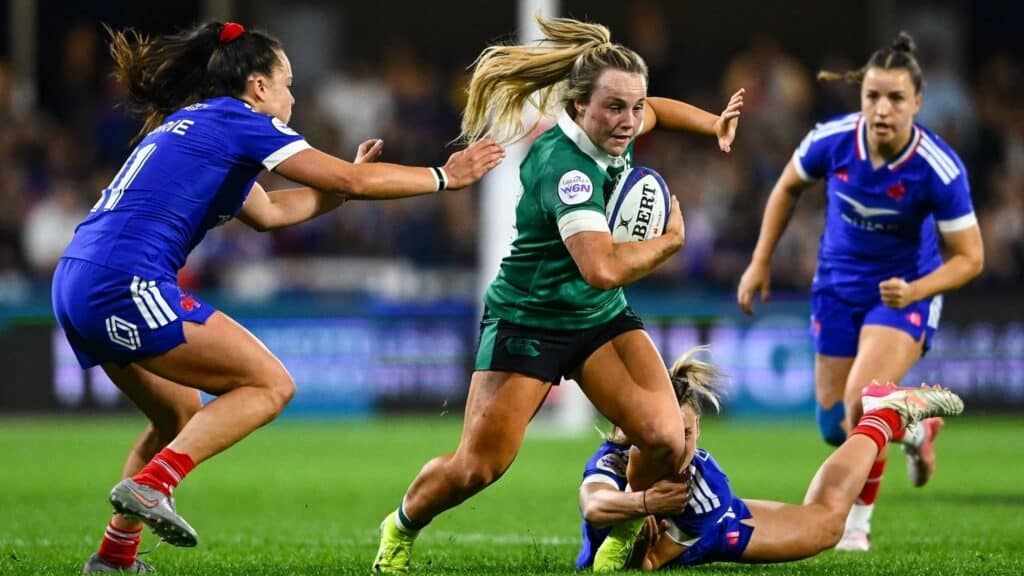
Ireland Player of the Year Aoife Dalton takes on the French defence during the game at Stade Marcel Michelin
An incensed Moloney-MacDonald lashed out when impeded illegally just six minutes in and towering replacement wing McGann – whose partner is Olympic boxer Grainne Walsh – squared up to several French players late in the third quarter.
But rugby’s great camaraderie was on display too, with photos after the match of a smiling Linda Djougang and the French replacement prop hugging warmly, and outside centre Aoife Dalton and her opposite number having swapped jerseys.
Despite Ireland’s understandable disappointment, in the grand scheme of things this was another hugely uplifting night for women’s rugby both on and off the field, a cracking contest unfolding against the backdrop of a wonderful occasion in this hotbed of French rugby.
There was a spectacular lights-show before the game and the late 9.10pm kick-off helped the atmosphere generated by a capacity crowd of over 17,000 packed into the steeply-banked stands of the renowned Stade Marcel Michelin.
Ireland had talked about the importance of silencing the crowd and they duly tore into their task like women possessed right from the off, finally going in front on 11 minutes through Moloney-MacDonald not long after Hogan’s disallowed score.
The try was converted by Dannah O’Brien, who had a good game in general alongside Lane, but agonisingly sent two kicks the wrong side of the corner flag and was also just off-target with a fairly long-range penalty as Ireland attempted to reduce the arrears to four points.
Well-prepared by forwards coach Alan O’Connor, who had an away win in Clermont as an Ulster player, Ireland’s pack was simply magnificent as they took the fight to the French relentlessly with superb purpose, physicality and aggression.
With her face full of fury, Wafer was a real force of nature, the uncompromising Moloney-MacDonald was pumped to the gills and the recalled Dorothy Wall monstrous and menacing in her almost incongruous trademark pink scrumcap.
Djougang, who played her club rugby in Clermont earlier in her international career, was relentless as always, vice-captain Tuite put in an immense shift despite being in the wars while Ellena Perry, Hogan and young skipper Erin King really fronted up too.
For all her dreamy baller attributes, we don’t think of Stacey Flood as a line-in-the-sand physicality tone-setter but Ireland’s elegant fullback definitely hit hard here after adopting the role of trash-talker-in-chief during the build-up by warning France to ‘be worried’.
The hat-trick hero against Italy, Beibhinn Parsons, hadn’t much chance to shine here but the previous Saturday’s 20-year-old debutant Robyn O’Connor more than justified her retention on the left wing here and this special prospect looks like she was born for these big stages.
Wexford youngster O’Connor had one big break down the left but she also came off her wing to get involved, made good decisions and despite being short of stature she relishes rather than shirks the physical combat.
Of course, the tone is set in that regard by the even more compact Dalton and the little warrior took a lot of physical punishment on both sides of the ball but fought hard right to the end having earlier saved a try with a great tackle into touch.
The young Offaly woman almost prevented the fourth French try, having brilliantly and bravely got under Teani Feleu as she ploughed over the Irish line, but No 8 Lea Champon was there to pluck the ball from her team-mate’s hands and get it down.
A third conversion by Carla Arbez added to what was now a cruelly unrepresentative scoreline, with the 19-point final margin of Ireland’s defeat ending up very similar to that on their previous visit two years ago when beaten 38-17 in Le Mans.
That was a real rearguard effort in Bemand’s first Six Nations match as head coach but he was heartened by Ireland’s defiance that afternoon, with their efforts being rewarded with late tries by namesakes Wafer and Dalton, both aged just 20 at the time.
The two sets of supportive parents were there alongside each other in the front row of the stand in Clermont and their respective daughters’ journeys to acknowledged world-class players sum up just how far this team has travelled in the intervening period.
Both Aoifes made the 2025 Six Nations Dream Team, with Wafer winning Player of the Championship and Dalton crowned Ireland Player of the Year, recognition of their excellent contribution to the rising Green Wave.
Ireland came into Bemand’s first Six Nations two years ago on the back of an emphatic whitewash the previous spring when they managed just three tries in five matches, a penalty try and two touchdowns by the then captain Nichola Fryday, who retired afterwards.
Contrast that to the 21 scored in last year’s Championship as Ireland secured a second consecutive third-placed finish, and Moloney-MacDonald’s effort on Saturday night was their 12th of this campaign with home matches against Wales and Scotland remaining.
After the tournament’s only down weekend, next up is this Ravenhill visit from Wales, who were pleased to pick up a four-try bonus-point from a 62-24 defeat against a rotated England team missing a good number of frontliners.
Then comes that eagerly-awaited Dublin date with struggling Scotland, who followed up their 84-7 Murrayfield mauling by England with a 41-14 loss in Italy and must now face France before coming to Dublin.
The fact Italy led Scotland 29-0 at the interval in contrast to trailing 45-10 at the same juncture seven days earlier in Galway is testament to Ireland’s impressive progress even though the coveted scalp of France has yet to be taken.
Three home wins was always the main target for this Six Nations and, although the team was keen to go after France following recent near misses against them, coming away with a win from Clermont was always going to be a big ask.
None of the celtic cousins have won a Six Nations match on French soil since the early noughties and only three times in Ireland’s 11 straight defeats there in this Championship has the visiting score reached double-digits.
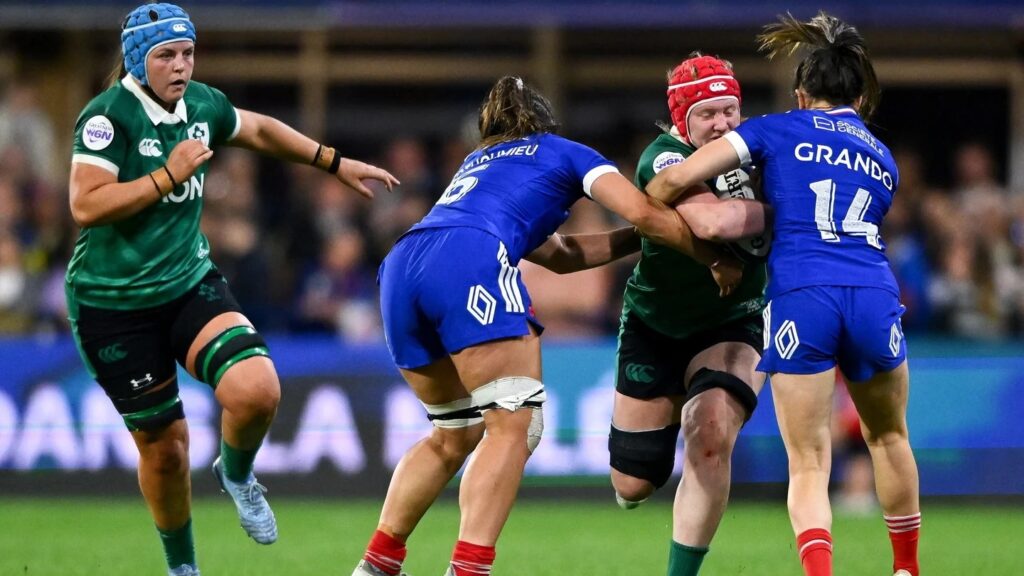
Last year’s Six Nations Player of the Championship Aoife Wafer was superb for Ireland against France
Although happy for his players to speak ambitiously, Bemand was reasonably relaxed ahead of this French fixture, noting that Ireland would keep pushing upwards and targeting the top four in the world whether the coveted victory came this time or not.
That Le Mans match two years ago, on the back of beating inferior opposition to lift the WXV3 title the previous autumn, showed Bemand that he had something to work with and one recalls the coach’s pride and positivity after the fight his side showed that day.
The team has come on so much since then but there’s a huge hunger and ambition to keep progressing and Bemand’s impassioned post-match television interview in Clermont on Saturday reflected the energised Englishman’s immersion in this project and cause.
It was stirring stuff from Bemand and likewise his skipper King, who held it together emotionally but spoke from the heart of the pride she has in this team, talked about small margins and big occasions, and affirmed her passion to keep growing the Green Wave.
Appointed aged just 22 to replace established co-captains, Sam Monaghan and the currently injured Edel McMahon, since last summer’s World Cup which she missed through injury, King has great respect for her predecessors and they are absolutely behind her.
We could see Monaghan, who had come off the bench, with her arm round King after the game, speaking earnestly as they walked, while back in the BBC studio in Belfast, temporary pundit McMahon was praising their successor with warmth and pride.
Ireland’s still invaluable elders in this largely youthful squad have King’s back and it all speaks to the togetherness of a very tight group who McMahon has often said about wanting to be the most connected in the world both on and off the field.
One of the most wonderful people you will ever come across in sport, Exeter Chiefs flanker McMahon has had a huge hand in shaping the fantastic culture in this Irish set-up and she still has plenty to offer as a player when fit again next season.
It wasn’t just Bemand’s words but his animated body language in that interview which was so striking, reflecting the absolute buy-in of coaches and players to the exciting journey Ireland are on and now they deserve great turnouts at Ravenhill and Aviva Stadium.
As with the New Zealand and France matches at the World Cup, Irish women’s rugby’s other outstanding 22-year-old leader Dalton was wheeled out to do media after a hard defeat and, despite having been battered physically, she brought her usual reflective clarity in Clermont.
The Celtic Challenge title-winning Wolfhounds skipper struck her trademark balance between honest assessment of where Ireland had come up just short and taking justifiable positives from an heroic effort from everyone involved.
The French crowd rose to applaud the Irish players as they did a lap of the pitch afterwards, acknowledging their heroic contribution to a fantastic Test match on a night when the harsh scoreline didn’t reflect a ferocious contest with the intensity and physicality off the scale.
The complete pride every Irish supporter rightly felt after that wonderful first half from those warriors in green was tempered by a sense of unease that their heroics hadn’t delivered sufficient scoreboard reward and unfortunately those fears proved well-founded.
France came through to maintain their unblemished home record against Ireland and remain on course for a Grand Slam showdown with England in Bordeaux, but they know Bemand’s women will keep snapping at their heels in the time ahead. This rivalry is just getting going.
There were just five Irishwomen wearing the same jersey number as that soggy autumn afternoon in Exeter but the fallout from last September’s World Cup quarter-final at Sandy Park was the unavoidable backdrop to the rematch on a balmy spring evening in Clermont.
Flood, Parsons, Dalton, O’Brien and Djougang remained in situ while there were positional switches for the other three surviving starters – Tuite, Wafer and Hogan – in a reshuffled Irish pack.
A further five of the run-on line-up from Exeter were on the bench here – Eve Higgins plus tight five forwards O’Dowd, Jones, Ruth Campbell and Sam Monaghan – with the three absentees being the pregnant Amee-Leigh Costigan and injured Aoibheann Reilly.
Lane, Perry and Moloney-MacDonald were promoted from that day’s replacements panel while the latter’s Exeter Chiefs team-mate McGillivray, who was in the World Cup squad, started this latest French clash.
The other trio who hadn’t featured against France last time were new skipper King and Wall, who both missed the World Cup through injury, along with rising star O’Connor, retained after a try-scoring debut display against Italy.
O’Connor getting the nod over Olympian Vicky Elmes-Kinlan and McGann meant Bemand’s starting team to face France had only one difference from that thumping wing against Italy in Galway, with Wall replacing Campbell in the second row.
We don’t need to revisit the trauma from that heartbreaking World Cup exit in any great detail but suffice to say there was no real luck of the Irish that day when it came to refereeing decisions and the deplorable bite on Wafer left a nasty taste in the mouth.
But aside from any natural animosity arising from that controversy, what was always going to add an extra edge was that ambitious Ireland have France in their sights as a significant scalp to target in their bid to reach fresh heights.
The visitors had a sense of unfinished business, not just from that stormy World Cup quarter-final but also last season’s Six Nations opener in Belfast, where Ireland felt that they let France off the hook.
This Six Nations showdown was between the teams ranked fourth and fifth in the world and the match certainly lived up to its billing on what was another wonderful occasion for women’s rugby before a full house at the splendid Stade Marcel Michelin.
After taking on world champions England in front of a capacity crowd of over 77,000 at Twickenham two weeks earlier, Ireland embraced the atmosphere rather than being intimidated and did their best to silence the home support with a ferocious start.
Fittingly it was Wafer who caught the kick-off, O’Brien put boot to ball and the chasing O’Connor was up to tackle an opponent into touch some 10 metres inside French territory, giving Ireland their first platform to attack.
Wall won the lineout at the tail, Wafer carried in midfield and Dalton pulled a pass back to O’Brien but a deliberate knock-on from French fullback Pauline Barratt stopped the ball reaching Parsons on the wing and she was rightly sinbinned with just two minutes gone.
Unfortunately, O’Brien’s penalty to the corner from 30 metres out went the wrong side of the flag so France were reprieved, but Wafer soon won a breakdown penalty, Tuite took the lineout and Dalton carried hard.
Moloney-MacDonald was slightly lucky to escape scrutiny after taking exception to an infringing French player but the penalty to Ireland stood, with O’Brien going into the left corner and King winning the lineout.
Several forwards carried before France interfered with Lane and a pumped-up Moloney-MacDonald tapped and went quickly but Ireland were held up over the line and the hosts had got away with not being back the requisite 10 metres.
Wafer and Moloney-MacDonald ran back at France after O’Brien caught the dropout but then the ball went loose and Hogan had to make an important tackle as the French sought to open out from deep in their own territory.
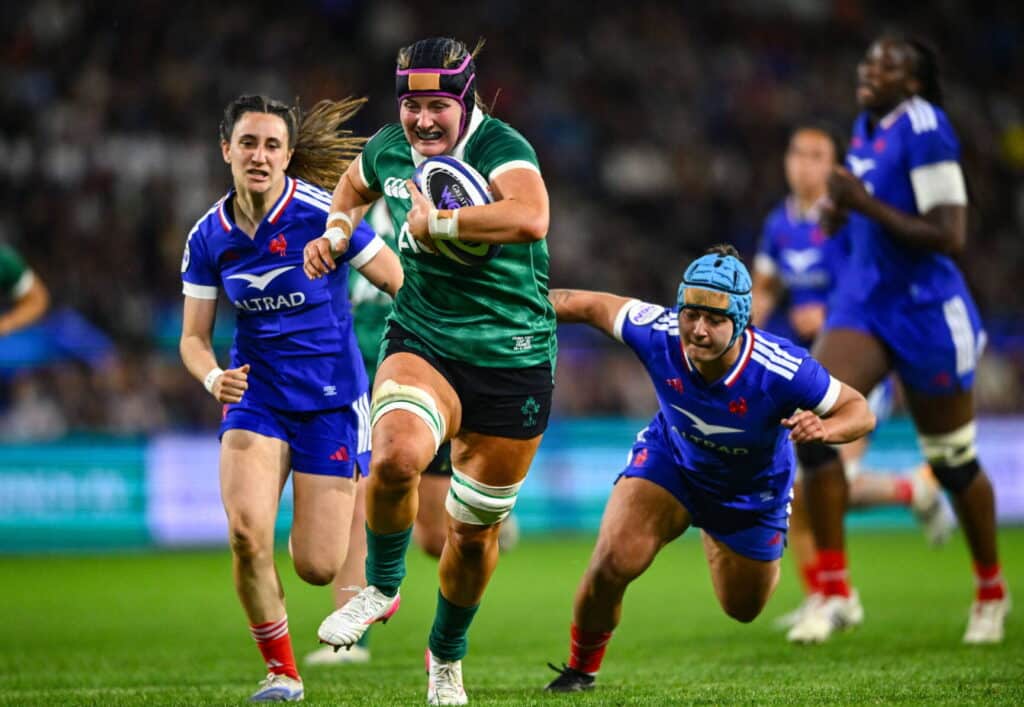
Young O’Connor made a superb break down the left and did brilliantly not to get isolated before the cavalry arrived in the shape of a rampaging Perry as a succession of fired-up Irish players swarmed forward like women possessed.
The referee awarded the try to Hogan but, just as O’Brien was about to strike the conversion, the call came that a TMO check was needed and the score was subsequently chalked off for a double movement by the Killinchy native.
But Ireland had a penalty advantage so there was no respite for France and Moloney-MacDonald got the touchdown after Tuite won the lineout and the forwards rumbled over against a heavier opposition pack.
O’Brien added the extras from wide on the left to put Ireland seven up but France drew level just after the quarter hour mark, loosehead prop Ambre Mwayembe being awarded the try and the TMO failing to intervene despite evident doubts about the grounding.
Mwayembe went on to pick up Player of the Match on a night when she and flanker Axelle Berthoumieu – who had served a lengthy ban after biting Wafer in Exeter – topped the tackle charts with 25 apiece.
Another contender for that award would have been outhalf Arbez who levelled the scores by converting the Mwayembe try and went on to put France in front for the first time through her own seven-pointer with half an hour remaining.
But Ireland continued to dominate that opening period, Moloney-MacDonald atoning for a lineout loss by winning a breakdown penalty and then Tuite galloping to the tryline after a great break through the middle by Wall early in the second quarter.
Again the try was awarded initially but replays proved that the French cover tackler had done brilliantly to prevent Tuite from getting the ball down so the Ulster forward was denied a score to garnish one of her very best performances in the green jersey.
King rightly raised the number of penalties France were conceding with the referee but they avoided anyone being binned despite persistent infringing as they remained under pressure from opponents with the bit between their teeth.
O’Connor showed good composure in letting a long kick from the great Pauline Bourdon-Sansus trickle dead, ensuing Ireland had a scrum back inside the French half, from where they launched further waves of pressure.
Referee Munarini lectured French captain Manae Feleu after another penalty concession before Ireland went to the corner and tried to maul their way over from the latest lineout take by vice-captain Tuite with Dalton joining in.
Ireland had scored twice from dominant mauls against France at Ravenhill last March and, although this drive was repelled, the siege was maintained and Moloney-MacDonald got her second touchdown of the evening a few phases later.
Once again, O’Brien was lining up the conversion attempt when it became apparent that there had been a little fumble by Lane at the base of the previous ruck so the try had to be disallowed because of that knock-on.
The pressure continued though, helped by a great choke tackle which led to an Ireland put-in, and they probed away until O’Connor was bundled out deep in the 22 before attacking again from the lineout after France had cleared to touch off their own throw.
Although the visitors ended the half on the front foot, France won a relieving penalty to trigger the half-time whistle and there were uncomfortable flashbacks to that day in Exeter when Ireland went in at the break having failed to turn pressure into points.
The forwards and Dalton carried hard at France in the early stages of the second half, and there was a penalty win by King at a breakdown, but the former soon had to make a scrambling tackle as the hosts tried to counter-attack.
But the team in blue were really starting to threaten and, although they were denied a try when a crucial, crunching hit by Dalton smashed her opposite number into touch near the Irish line, the score the French craved came with half an hour remaining.
Bemand brought on five replacements at once – perhaps surprisingly early too with just 48 minutes gone – as McGann, Higgins, O’Dowd, Jones and Monaghan took over from O’Connor, McGillivray, Perry, Moloney-MacDonald and Hogan respectively.
France struck for their second try almost immediately, Arbez giving them the lead for the first time by using good footwork to elude Lane and O’Dowd in scoring a try which she then converted to make it 14-7.
A few half-breaks by Higgins gave Ireland encouragement but O’Brien was just off-target in attempting to reduce the arrears to four with a straight penalty from fairly long-range late in the third quarter just before Wall – who had made 17 carries – gave way to Campbell.
The French crowd were responding as their team became more dominant and, despite a great tackle by fullback Stacey Flood, winger Anais Grando got the third home try in the right corner 12 minutes from the end with the Ireland defence stretched.
Arbez couldn’t convert this time, so any try from Ireland would bring them back into losing bonus-point territory and within a single score of snatching an historic victory but unfortunately their best chance came and went thanks to another error.
Eilis Cahill replaced Djougang going into the final 10 minutes and Ireland had a penalty to the corner after Higgins gained ground by selling a dummy and then Dalton danced and darted, but for the second time on the night O’Brien kicked the ball dead.
That felt like a big blow to Irish hopes and sure enough France effectively controlled the remainder of the match, though it looked like Dalton had heroically prevented Teani Feleu from scoring the bonus point try with just over a minute remaining.
Dalton did so well to get under the powerful Feleu as she crossed the Ireland line and wrestled her onto her back but the supporting Champon plunged over, albeit again with some doubts about the try’s legality, with Arbez converting.
The harsh scoreline of 26-7 now was totally unreflective of this hard-fought, fantastic contest and, with Katie Whelan replacing Lane at scrumhalf in the final minute, unbowed Ireland went after a consolation score.
Flood ran back a kick, King and Parsons took it on and Dalton cut in-field from an O’Brien pass but the subsequent grubber from Flood went into touch to trigger the final whistle and confirm France’s ninth consecutive victory over Ireland.
IRELAND (v France): Stacey Flood; Beibhinn Parsons, Aoife Dalton, Nancy McGillivray (Eve Higgins, 48), Robyn O’Connor (Anna McGann, 48); Dannah O’Brien, Emily Lane (Katie Whelan, 79); Ellena Perry (Niamh O’Dowd, 48), Cliodhna Moloney-MacDonald (Neve Jones, 48), Linda Djougang (Eilis Cahill, 70), Dorothy Wall (Ruth Campbell, 58), Fiona Tuite, Brittany Hogan (Sam Monaghan, 48), Erin King (capt), Aoife Wafer.
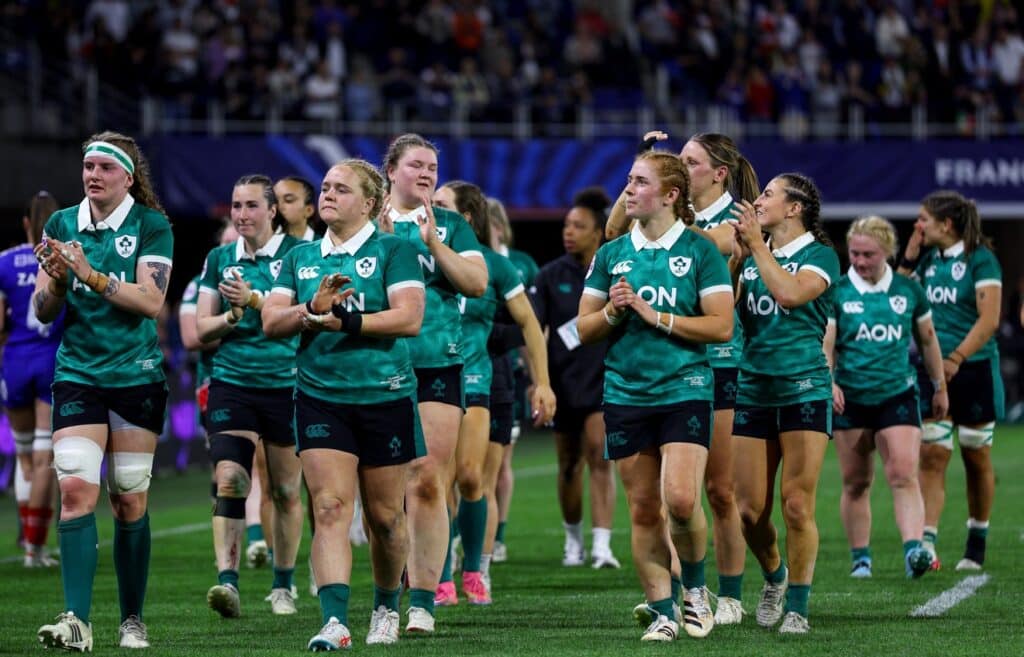
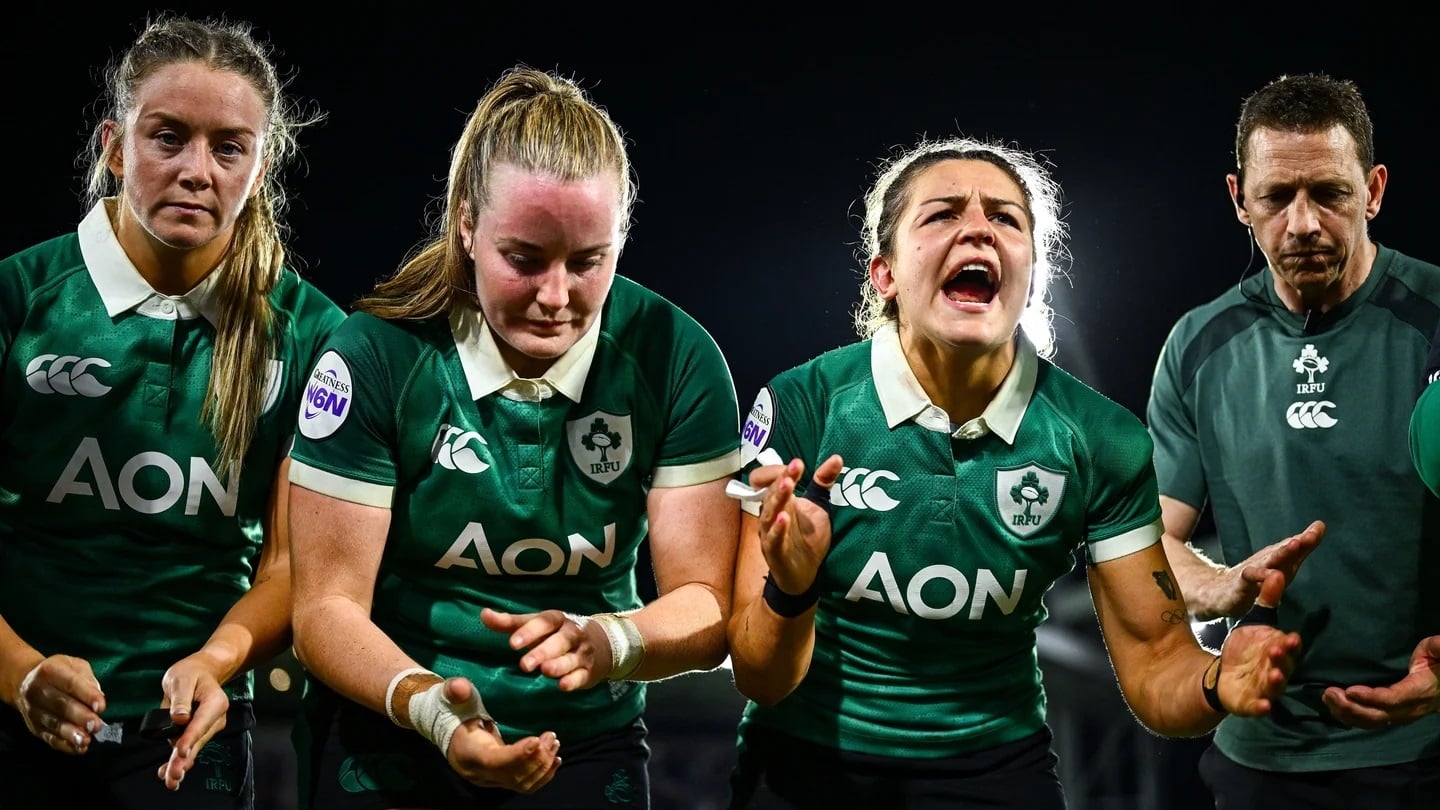
The Ireland players received applause from the appreciative crowd in Clermont during their post-match lap