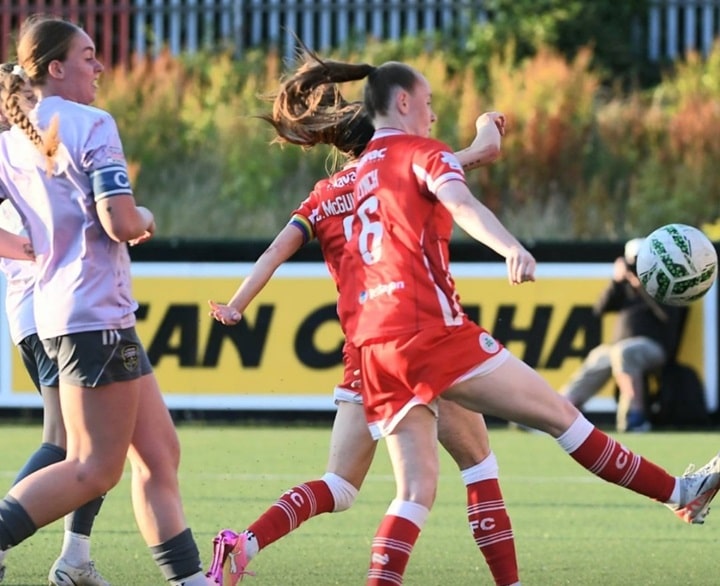

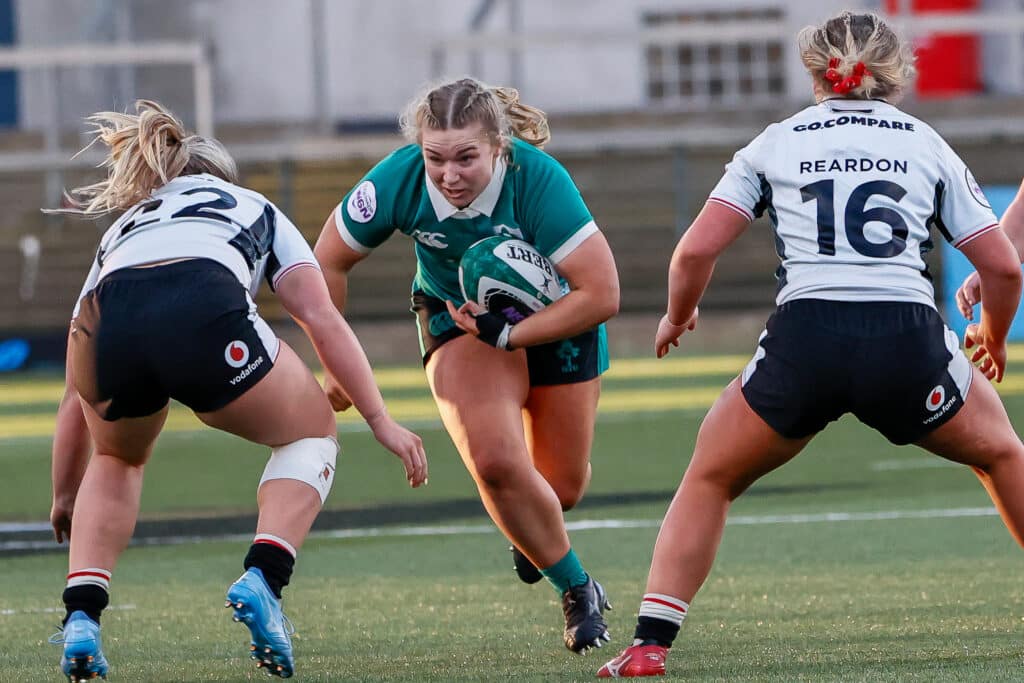
Ulster’s Sadhbh McGrath on the charge for Ireland against Wales at Ravenhill (Pic: Colin Molloy)
By Richard Bullick
AOIFE Wafer picked up Player of the Match against Wales for the third year running as Ireland returned to winning ways with a 33-12 Ravenhill victory ahead of Sunday’s historic clash with Scotland at the Aviva Stadium (2.30pm).
More than 30,000 tickets have been sold for the first standalone women’s match ever to take place at Irish rugby headquarters and former co-captain Sam Monaghan makes her first Six Nations start in over two years in the only change to the team which beat the Welsh.
Like last spring’s game against Wales in Newport, Wafer crossed the whitewash twice last Saturday evening, and this time Ireland’s taliswoman also sent Beibhinn Parsons away for a try with a wonderful offload.
There was also a Belfast brace for skipper Erin King’s other fellow back row forward, proud Ulsterwoman Brittany Hogan, who got her touchdowns with the clock red in either half, while Dannah O’Brien kicked four conversions and hit an upright with her other attempt.
Ealing Trailfinders fullback Niamh Gallagher, one of just two backs named in the Ireland replacements panel, came on to win her first cap as Bemand’s team bounced back from their away defeat against France a fortnight earlier in round three.
That made it an unforgettable evening for the English-born Gallagher, who has joined Katie Whelan, Eilis Cahill and Robyn O’Connor in wearing the green jersey for the first time over the past few weeks as Bemand continues to develop depth in his squad.
Although they had a try disallowed, Ireland’s margin of victory here was the same as the quantum of their defeat to England in the opening game at Twickenham last month, albeit their narrowest win against Wales in the last three encounters.
The impressive 36-5 victory in Cork two years ago was a big breakthrough for the Green Wave, and Ireland then enjoyed a 40-14 away win last season, but Wales have improved since that most recent encounter at Rodney Parade.
Wales arrived in Belfast still searching for their first Six Nations win since 2024, but with fresh heart after picking up a bonus point by scoring four tries against an admittedly depleted England in Bristol last time out.
By contrast, they crossed the Ireland line only once on this Ravenhill visit, while the hosts scored five tries to take their tally for this campaign to 17, albeit they were mostly less spectacular than those served up in last month’s 57-20 thrashing of Italy in Galway.
The awesome Wafer has doubled up on each of her last three outings in Belfast, with Saturday’s two tries matching her exploits against Australia two autumns ago and France in the 2025 Six Nations when she went on to win Player of the Championship.
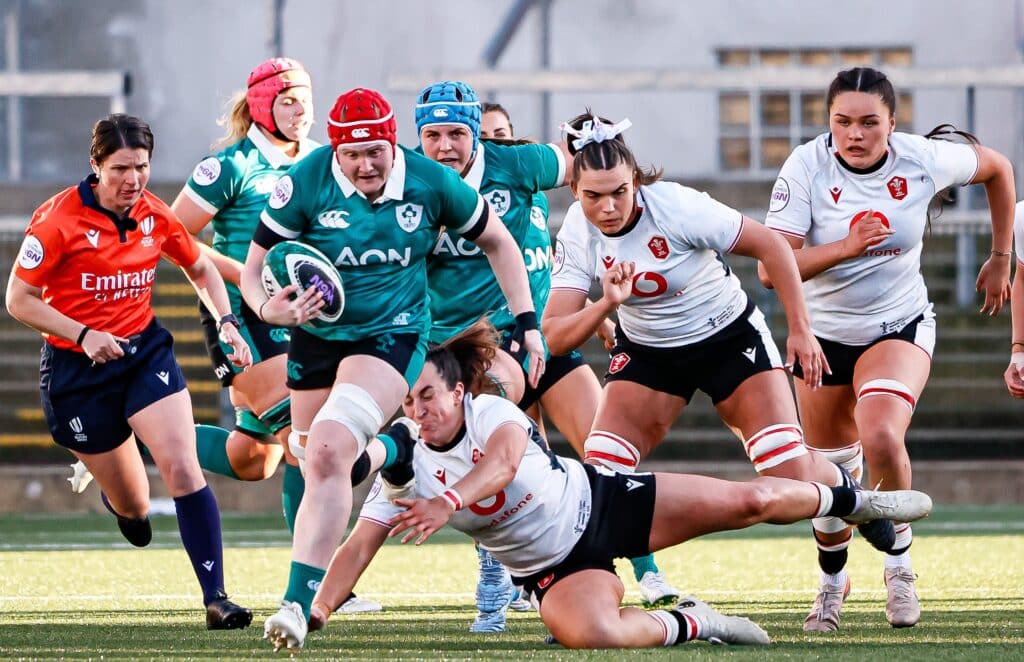
Ireland’s Aoife Wafer on the attack during her Player of the Match performance (Pic: Colin Molloy)
Here the world-class loose forward complemented her two tries by making 89 metres from 20 carries, beat no fewer than nine defenders, delivered four offloads, completed 13 tackles and won a great turnover penalty for good measure.
She also provided the assist for that touchdown which puts Parsons top of the try-scoring chart for backs from any country in this Six Nations and the hat-trick hero against Italy in her native Galway is third in the standings for defenders beaten.
Wafer and Hogan are in the top four for carries, behind only the English and French fullbacks, while the utterly relentless King’s ruck arrival stats are in a league of their own, underlining the quality of Ireland’s incredible back row.
Bemand has had a very settled side in this Six Nations, with a dozen players making their fourth consecutive start last weekend and the recall of Eve Higgins being the only change from the run-on line-up last time out against France.
Higgins showed her class with a couple of brilliant breaks against Wales while centre partner Aoife Dalton demonstrated her worth with several vital tackles in another hugely industrious, shrewd display despite little opportunity to shine with ball in hand.
One of Dalton’s best hits saw her bury an opponent into touch in the 47th minute, with the big break up the middle by Wafer and Higgins from the resulting lineout leaving Wales so stretched that Jasmine Joyce got herself sinbinned for infringing.
That levelled up the numbers at 14 apiece as Ireland hooker Cliodhna Moloney-MacDonald was already on the naughty step for half-heartedly kicking out when held by the leg, an incident which caused the TMO to intervene after the referee had just given a penalty.
There was no damage done by Moloney-MacDonald’s boot but the action conceivably could have got her red-carded and, after escaping punishment for lashing out in Clermont too when interfered with after a ruck, the experienced Exeter Chiefs hooker needs to be careful.
Hogan was called upon to throw into a lineout following Moloney-MacDonald’s yellow card but it wasn’t straight so Ulsterwoman Neve Jones had to be brought on for the ensuing scrum with young winger O’Connor temporarily withdrawn.
Already looking at home at this level, O’Connor hadn’t much chance to add to her debut try but Bemand was pleased with his side’s scores from close-range after the frustration of having three tries disallowed in the French clash and also being held up over the line.
This time they had one chalked off, Jones belatedly denied a score in front of her own provincial crowd when the TMO intervened, just as Wales were about to restart, to flag a technical infringement in the maul leading up to the replacement hooker touching down.
That was by Linda Djougang, scorer of two tries against Wales last year, who only gave way to rookie Cahill for the final few minutes here on an evening when Bemand maintained his recent habit by making five substitutions at once.
Young Ulsterwoman Sadhbh McGrath, Jones, former skipper Sam Monaghan, fellow lock Ruth Campbell and fullback Gallagher took the field on the hour mark as one big gang, with Ellena Perry, Moloney-MacDonald, Fiona Tuite, Dorothy Wall and Stacey Flood going off.
When skipper King gave way to Grace Moore – recalled to a bench which had a 6:2 split for the first time this Six Nations – the fact her deputy Tuite was already off meant ex-captain Monaghan took over the official on-field leadership role.
An alternative within the leadership group was Wolfhounds’ Celtic Challenge title-winning captain Dalton, who Bemand revealed had addressed the team earlier in the afternoon, and like King and game controller O’Brien was born as recently as 2003.
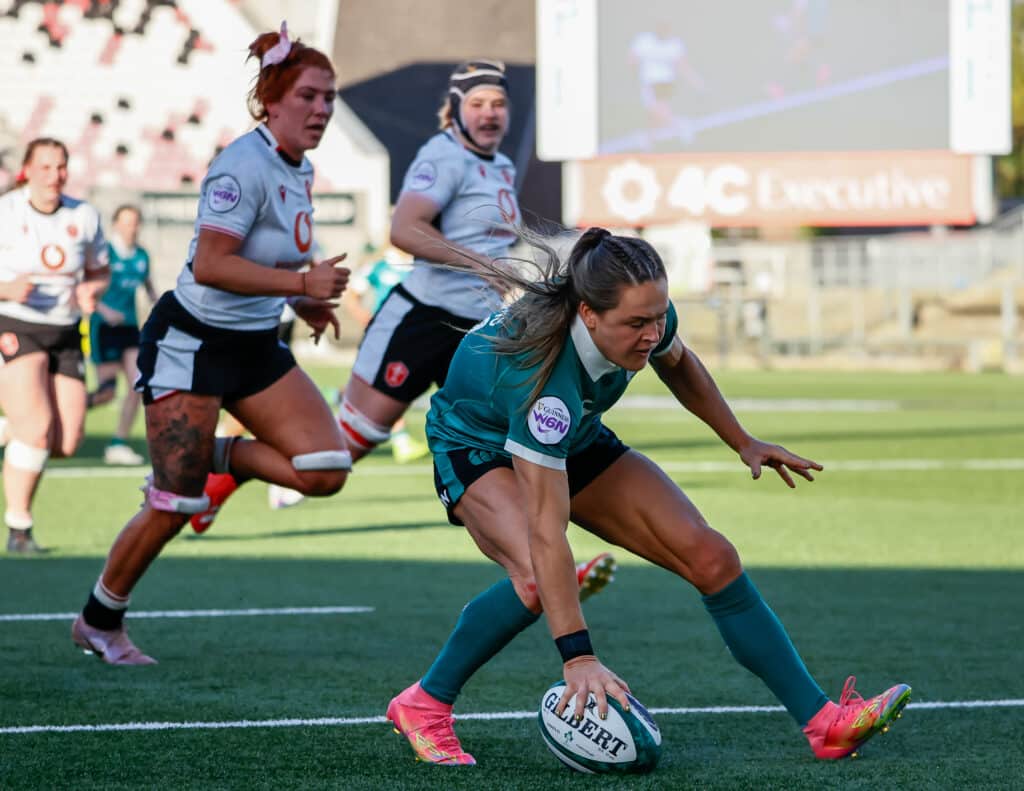
Winger Beibhinn Parsons touches down for Ireland’s second try against Wales (Pic: Colin Molloy)
But the fact King’s joint predecessor Monaghan could step in as acting captain without any awkwardness is testament to both Erin and Sam, along with the fantastic culture in this tight-knit Irish squad.
Monaghan and the currently injured Edel McMahon have left an indelible legacy as co-captains but King is proving a worthy successor and she spoke warm wWinger Beibhinn Parsons touches down for Ireland’s second try against Wales (Pic: Colin Molloy)
ords of praise afterwards for Tuite, Monaghan and Dalton along with her fellow back rows.
It says everything about how much Ireland have progressed under Bemand that this comprehensive victory over Wales – who beat them 31-5 as recently as the 2023 Six Nations – didn’t really get everyone very excited.
That perhaps partly reflects the heightened expectations created, how this wasn’t an especially exciting game in terms of free-flowing rugby and a sense that Ireland have an even more complete performance in them.
But it was also arguably an indictment of the relatively underwhelming occasion, not helped by a disappointing crowd – for these great times we’re living in – of just under 5000, which left two sides of Ravenhill completely empty and the stand at one end sparsely populated.
Many will justifiably feel that this match should have taken place in the Irish women’s team’s spiritual home in Cork and, whatever the political considerations, lessons must be learned when it comes to the allocation of future fixtures.
After three wonderful occasions at Twickenham, in Galway and most recently Clermont, Ravenhill had a hard act to follow for sure, but this stadium simply isn’t as suitable for Ireland women’s matches as Virgin Media Park or the newly developed Dexcom.
The fact this win was expected and the lack of much champagne rugby may have been becalming factors too but Ireland deserve exceptional credit for how quickly they have become firm favourites for these games.
Let us never, ever overlook or underestimate the work which has put Ireland in this position now, what these heroes have to be and how much they have to give of themselves to be where they are relative to Scotland, Wales and Italy.
This is an ambitious group who are infectious about becoming better, they always want to be held to the highest standards – and do so themselves – but it would be wrong not to acknowledge what massive strides have been made in a relatively short time.
Wales had a lot of possession in the early stages without anything material to show for it and Ireland gradually grew into the game before Flood rolled a kick through for the chasing O’Connor which the visitors were able to touch down.
But flyhalf Llecu George sent the goal-line dropout straight into the arms of Wafer, who charged well into the Welsh 22 before a nice pass back inside by Moloney-MacDonald to Flood got Ireland to within five metres of the tryline.
They came away with seven points, the powerful Wafer forcing her way over in the 12th minute and O’Brien adding the extras from fairly well to the left of the posts despite having to shield her eyes from the early evening sun.
Dalton shot up to make a crunching hit on three-time Olympian Jasmine Joyce, but Ireland soon needed a brilliant tackle by Parsons in her own 22 on Carys Cox after a speculative punt by George had sat up for the other Welsh centre Courtney Keight.
But Wales were level by early in the second quarter, the diminutive Dalton somehow stopping the enormous Sisilia Tuipulotu under the posts before flame-haired lock Georgia Evans plunged over with seasoned scrumhalf Kiera Bevan converting.
A good period of pressure followed from Ireland and, although Moloney-MacDonald was penalised just short of the line for crawling after the tackle, Wales weren’t really able to lift the siege.
With the half hour mark approaching Wafer went to the blindside after picking up at the back of a scrum just outside the opposition 22 and a wonderful offload put Parsons away for her fourth try of a productive campaign.
There was no action taken after the TMO did a background check following an upright tackle by King but Ireland were glad of a fantastic, crucial tackle by Dalton on Cox as Wales spread the ball left and counter-attacked at top pace after a lineout steal.
King and Higgins both won turnovers for Ireland, the forwards carried with intent – Perry has been a great addition to this set-up since last summer – and young O’Connor showed her appetite to explode into contact despite being small.
Wales seemed to have been reprieved when Ireland finally went off their feet on the visitors’ 22 but George missed touch, there was an audacious piece of skill from Flood flicking the ball up from boot to hand and the action continued deep into over-time.
Higgins got another turnover, King won a breakdown penalty, O’Brien got good distance on her kick to the corner, Tuite claimed Moloney-MacDonald’s throw and soon seemed to be rampaging to the line.
The Ulster lock was met and driven back by a Welsh welcoming party of three but Ireland kept probing through a series of frantic carries until Hogan calmly spotted a gap, picked up the ball and placed it over the line with the clock now 3:18 into the red.
O’Brien’s straightforward conversion put 12 points between the teams, making it a pretty satisfactory first half for Ireland albeit the penalty count against them was higher than Bemand might have liked.
The alert Dalton managed to grab O’Brien’s second half kick-off and dart infield but Ireland suffered a blow when Moloney-MacDonald was sinbinned and Jones had to be brought on for O’Connor for the scrum after a crooked delivery by emergency thrower Hogan.
Ireland defended well despite their numerical disadvantage, helped by Wafer winning a breakdown penalty and a scrambling Dalton getting across to smash a Welsh player into touch after Parsons had to make a tackle inside.
The resulting lineout led to the big breakout by Wafer and Higgins and the Joyce yellow card but Ireland were left frustrated when a long pass to Dalton on the outside by her centre partner was questionably adjudged as being forward.
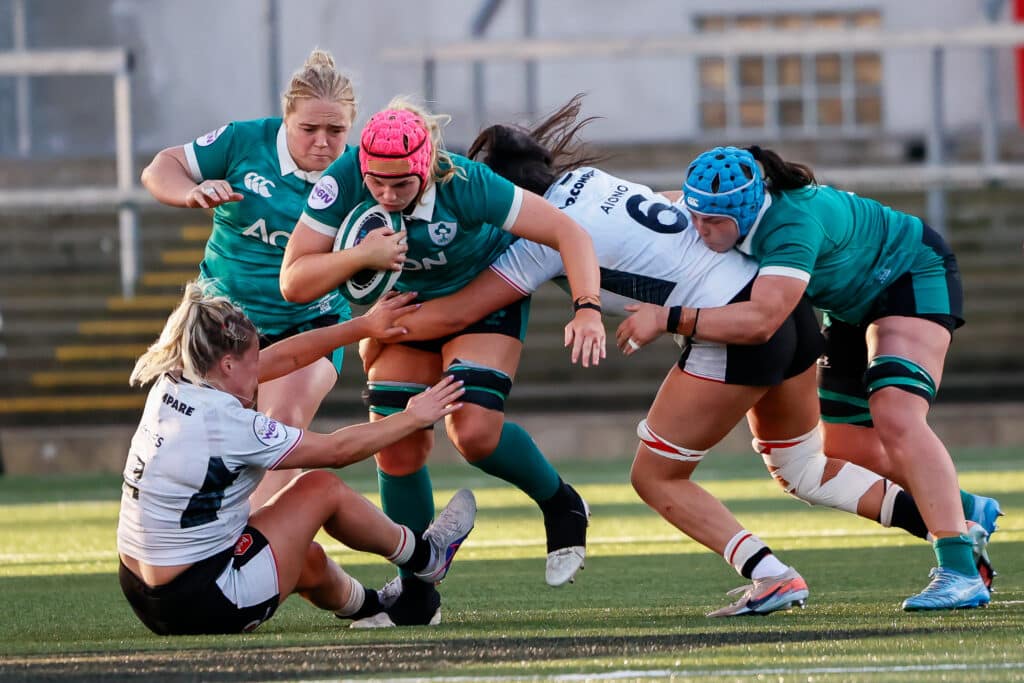
Dorothy Wall runs at the Welsh defence in the Six Nations match in Belfast (Pic: Colin Molloy)
After Ireland had been restored to 15 players, O’Connor was among those who were prominent in the lead-up to Wafer’s second try, the Harlequins star forcing her way over from close-range again after a series of carries, the last two by Dalton and Djougang.
O’Brien’s conversion of this bonus-point try made it 26-7 with 55 minutes gone but Ireland needed another great tackle by Parsons to snuff out a threatening Welsh attack midway through the half just before Bemand made his five changes.
The Jones try was disallowed belatedly at the behest of the TMO and, although Wales scored late on through that accurate cross-kick by George to Joyce – whose wife Alisha Butchers was now on as a replacement – Ireland deservedly had the last word.
Higgins couldn’t connect with Wafer after a big break and Dalton was dumped by a ferocious tackle by Joyce wide on the right but the green waves kept coming and Hogan got her second try with O’Brien’s successful conversion triggering the final whistle.
IRELAND: Stacey Flood (Niamh Gallagher, 60); Beibhinn Parsons, Aoife Dalton, Eve Higgins, Robyn O’Connor (Neve Jones, temp 43-53); Dannah O’Brien, Emily Lane (Katie Whelan, 67); Ellena Perry (Sadhbh McGrath, 60), Cliodhna Moloney-MacDonald (Neve Jones, 60), Linda Djougang (Eilis Cahill, 78), Dorothy Wall (Ruth Campbell, 60), Fiona Tuite (Sam Monaghan, 60), Brittany Hogan, Erin King (capt; Grace Moore, 65), Aoife Wafer.